Architecture
Quick guide to Carcassonne Architecture
1. Gallo-Roman Architecture (3rd–5th century)
• Earliest fortifications built by the Romans.
• Large stone blocks in straight lines, often visible in the lower parts of the inner walls of the Cité.
• Foundation for the later medieval fortress.
2. Romanesque Architecture (10th–12th century)
• Rounded arches, thick walls, small windows, simple ornamentation.
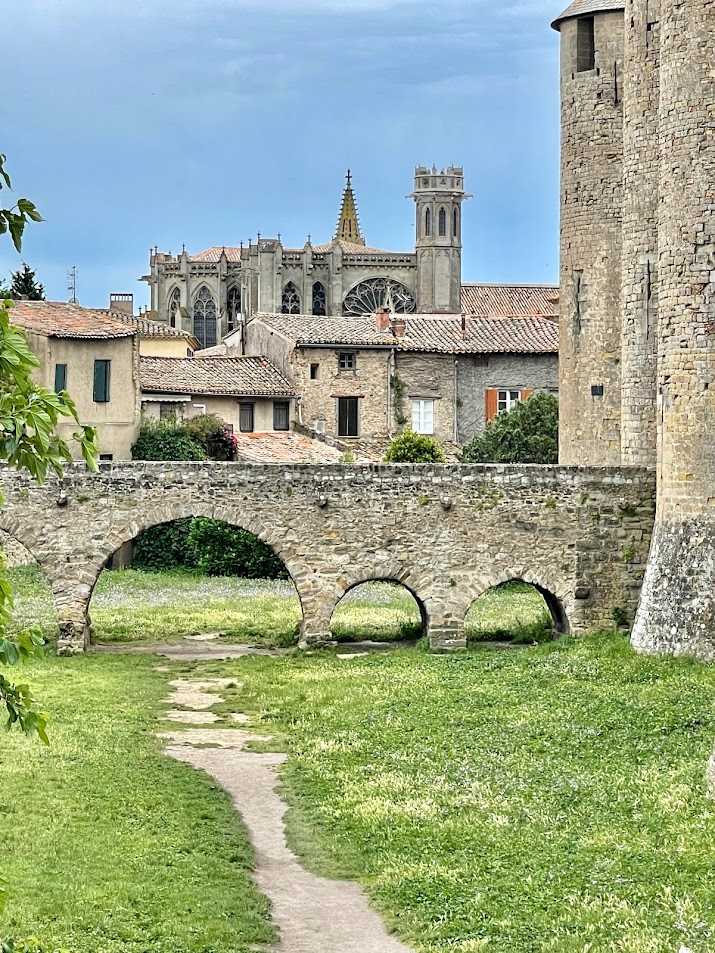
• Seen in the Basilica of Saints Nazaire and Celse (the nave and transept).
• Emphasizes strength and spirituality through solid, heavy forms.
3. Gothic Architecture (13th–15th century)
• Pointed arches, ribbed vaults, and large stained-glass windows.
• Visible in the choir and rose windows of the Basilica.
• Represents the shift from fortress-like to more light-filled and elegant design.
4. Medieval Military Architecture (12th–14th century)
• Double ring of walls, towers, barbicans, moats, and gates of the Cité de Carcassonne.
• Functional features like machicolations, arrow slits, and drawbridges.
• A masterpiece of defensive design — one of the best-preserved in Europe.
5. Bastide Urban Planning (13th century)
• Found in the Bastide Saint-Louis (the “new town” across the river).
• Grid layout with a central square (Place Carnot).
• Reflects early urban design emphasizing trade, civic life, and symmetry.
6. 19th-Century Neo-Medieval Restoration
• Led by architect Eugène Viollet-le-Duc.
• Added conical slate roofs and decorative details to towers.
• Blends authenticity with 19th-century romantic vision of the Middle Ages.